Rubber Band Car Challenge
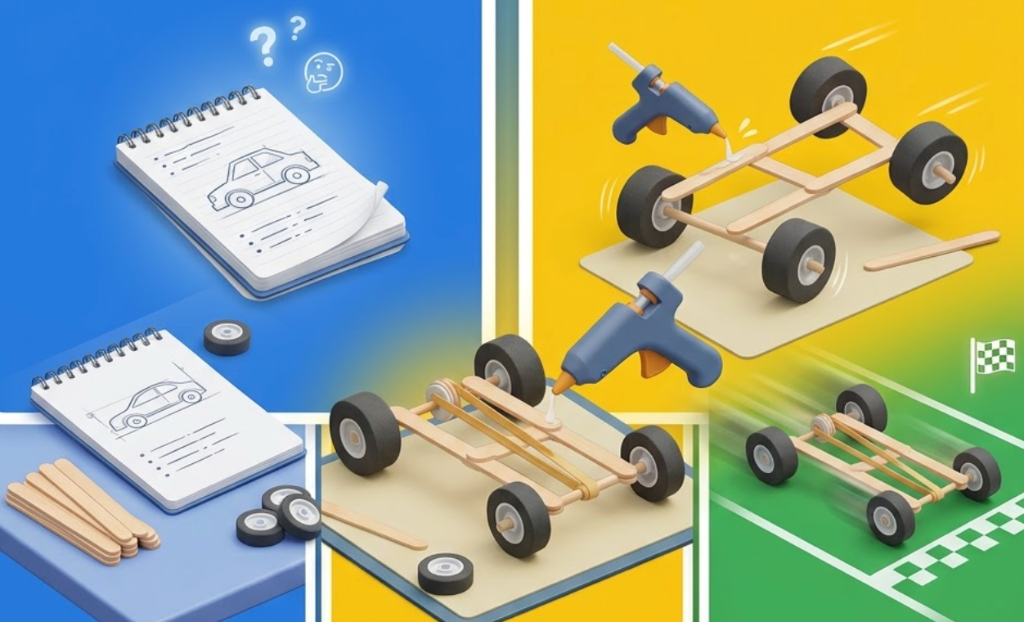
Build a rubber band-powered car, compete in three challenges, then redesign a key part using 3D CAD and printing.
Build a rubber band-powered car using popsicle sticks, EVA foam wheels, pop rivets, and rubber bands — then compete against other teams to go the farthest, straightest, and fastest. After the competition, analyze what went wrong and redesign a key part using 3D CAD and 3D printing.
This project guides you through the design-build-test-improve cycle. Every decision you make during building has a consequence during testing — pay attention to what works and what does not.
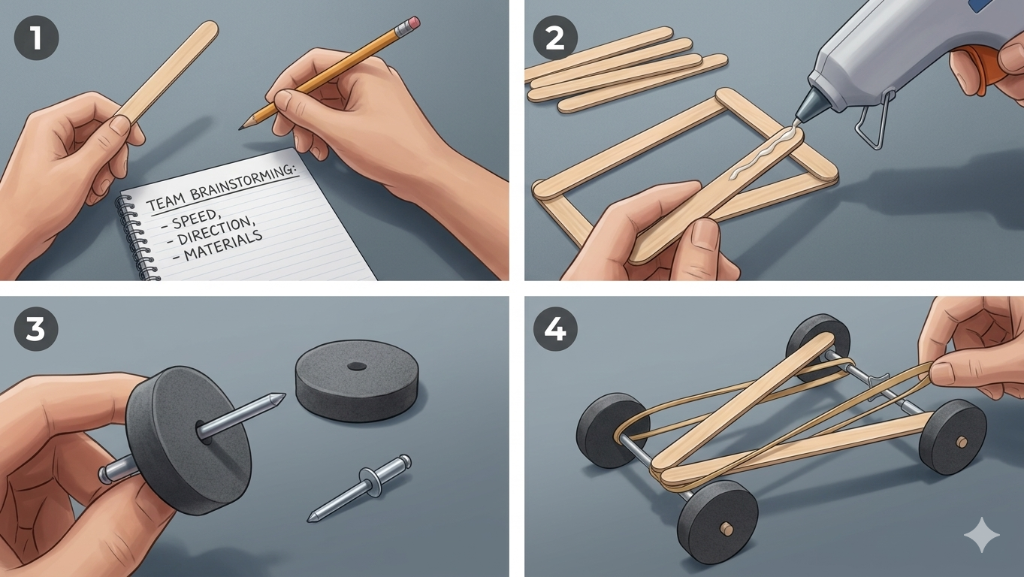
Before you touch any materials, discuss these questions with your team:
- • What makes a car go far? What makes it go straight? What makes it go fast?
- • Looking at your materials — which ones affect speed? Which affect direction?
- • What is your team's biggest concern about the build? Name it now before you start.
Write down your team's answers. You will compare them to your actual results after the competition.
Use only the provided materials. The clock starts when the facilitator says go. Keep these engineering principles in mind:
⏱️ A facilitator will call time at 10 minutes. Whatever state your car is in at that point is your competition car.
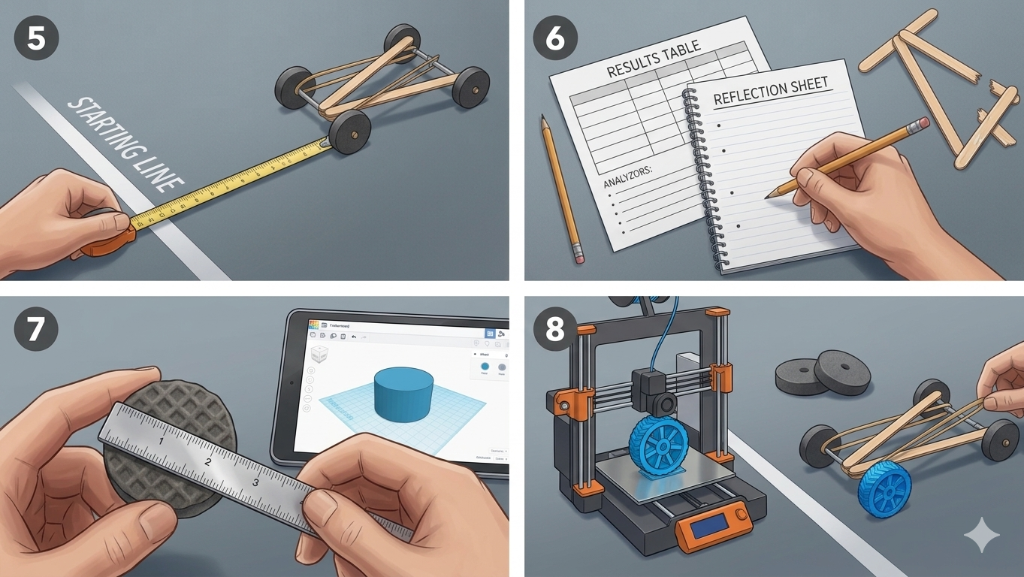
Teams will be called up one at a time. Each team gets one wind, one release, and one official measurement per challenge. Enter your results and the best result in the room below.
📊 Enter Your Results
Distance (cm)
Farthest Distance — straight-line distance from start to stop
Straightness (cm)
Straightest Line — deviation from center line (lower = better)
Speed (sec)
Fastest Car — time to reach 3m finish line (lower = better)
Do not skip this step — the reflection is where the real learning happens. Answer each question as a team, then save your responses.
Completion
0/5 answered
What was your car's biggest failure during the competition? Be specific.
Was the failure caused by design, materials, or assembly? How do you know?
Quick pick (optional):
If you had 5 extra minutes to fix one thing before another run — what would it be and why?
Look at the winning car for each challenge. What did they do differently from your team?
Which of the five materials had the most impact on performance? Why?
Quick pick (optional):
Powered by SilidLMS